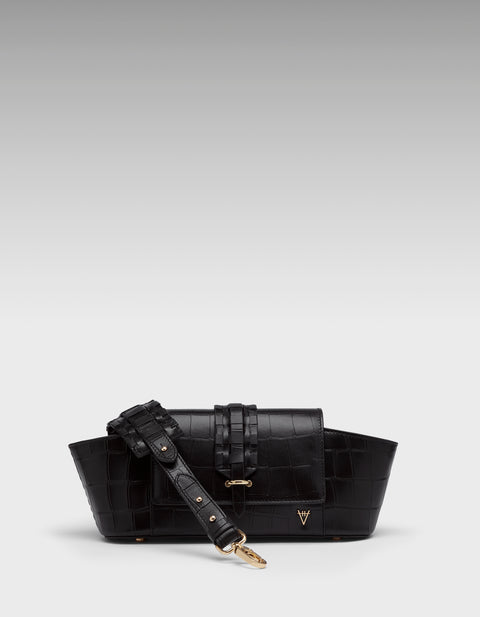
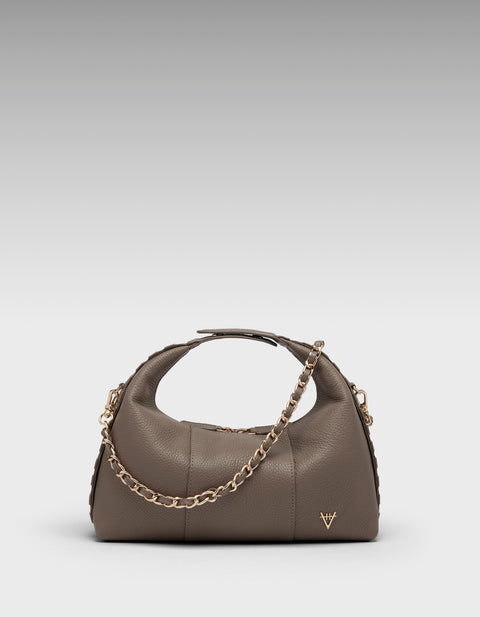
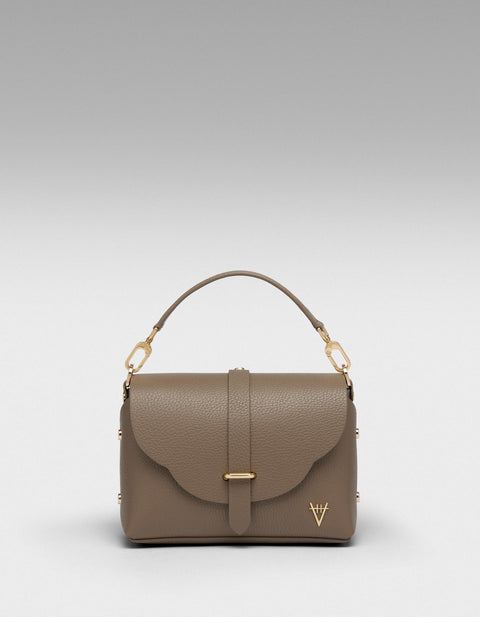
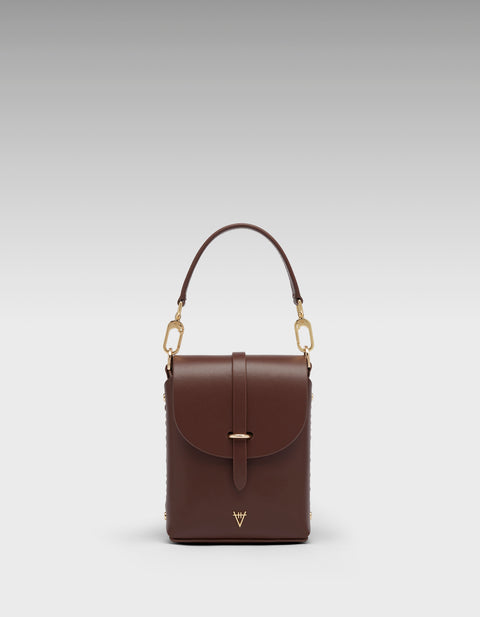
The Hide Before the Bag
Before it becomes anything, a Hiva piece is simply a hide. A flat piece of leather carrying its own marks, its own character, its own nature — with no form yet at all.
Most of the decisions that let a finished bag keep its shape and character for years are made long before the first stitch. Choosing the right hide, using the right part of it, and shaping every detail around the material — this is the real craftsmanship, and the part that usually goes unseen.

Choosing the Hide
It all begins with selection.
No two hides are the same, and not every hide can become the same product. Each one is inspected individually — for grain structure, thickness, firmness, and the natural marks it carries.
In our workshop we work primarily with full-grain and top-grain calf and lamb leather.
Full-grain leather is the outermost and strongest layer of the hide. Because it’s used without sanding, it keeps its natural grain, its texture, and the marks of a life. As the layer where the fibres are densest, it’s also the most durable.
A faint scratch on the surface or a small variation in the grain isn’t a flaw. On the contrary, it’s proof that the leather’s natural structure has been preserved.
We don’t hide these marks. We try to understand them, and place them where they belong within the design.

Reading the Hide
Leather doesn’t behave the same way across every part of the hide.
The area running along the spine has the densest fibre structure, which makes it the strongest and most stable region. The base of the bag, its handles, and the main load-bearing panels are cut from here.
The belly and legs are more flexible and softer. For that reason they’re used for parts that carry less stress, or in areas where a little give is no problem.
This is exactly why quality leatherwork can’t be fully automated.
A machine’s aim is to cut as many pieces as possible from a single hide.
A maker’s aim is to read each hide individually and place every pattern piece where the material is strongest. There may be more waste — but in return, a bag emerges that holds its shape for years.
Cutting and Preparation
Once the right area is identified, the patterns are laid out and the pieces are cut one by one.
At this stage, grain direction is critical. Leather stretches naturally in a certain direction. When straps or load-bearing pieces are cut against that direction, they can lengthen and deform over time. Cut in the right direction, they hold their form far longer.

After cutting, preparation for assembly begins.
Where the leather will fold or overlap, it’s thinned down. This keeps the joins from building up bulk, lets the seams sit more cleanly, and gives the bag a more refined silhouette.
Surfaces are conditioned, pieces are prepared — and only then does the bag truly begin to take shape.
Why This Is the Most Critical Stage
By the time a bag reaches the sewing stage, most of its quality has, in fact, already been determined.
Flawless stitching laid over a poorly chosen or poorly cut hide isn’t enough to create a lasting product.
A well-chosen, well-read, and well-prepared hide, on the other hand, gives the maker a solid foundation to build something that will live for years.
This may be the least visible part of production.
Yet the answer to why a good bag grows more beautiful over time lies exactly here.
Because quality leather softens as it ages, its colour deepens, and it gains character. And its ability to hold its shape isn’t the result of the first stitch — but of the right decisions made long before.
The story of a Hiva bag begins right here; when it isn’t even a bag yet, at the moment it’s still only leather.